Nerves and Clay: How Did the Women's Roland Garros Go?
This weekend marked the end of the French Open – one of the oldest Grand Slam tournaments. The women's singles brought many surprises, and it's unlikely anyone could have predicted how things would unfold. There were indeed quite a few upsets. Who would have expected a player ranked 361st in the world to reach the semifinals? But let's go through everything step by step.
Who is Lua Boisson?
The women's French Open was incredibly exciting, and the intrigue began right from the first rounds of the main draw. For instance, Angelina Kalinina pulled off an upset by defeating Avanesyan. She did it with such ease, as if she was just out for a stroll. And Lua Boisson, whom we will discuss further, managed to overcome Elise Mertens. The Belgian showed nothing in the match against the Frenchwoman, which cost her an exit in the very first round.
Lua Boisson didn't stop at the first round; the Frenchwoman continued to surprise everyone. In short, before the start of the French Open, she was ranked 361st in the world, and now she has climbed to the 65th position, moving up almost 300 spots. Boisson sensationally reached the semifinals, defeating the world number three Jessica Pegula and world number six Mirra Andreeva along the way. This wasn't just a stroke of luck but a result of her tremendous hard work. Lua earned this through her patience and diligence.
On May 13 last year, Boisson entered a Challenger match in Paris but withdrew in the third set due to a cruciate ligament tear. Her recovery took nine months, and she only returned to action in February. During this time, Lua managed to win an ITF series tournament in France and received a wild card for the French Open. You already know what came of it. Boisson became the top-ranked player in France, earned $786,000 from the French Open (whereas her career prize money before this was $148,000), and her Instagram following skyrocketed from 8,000 to 251,000 followers. This tournament completely changed the life of the 22-year-old Frenchwoman, who will now be even more interesting to follow.
Andreeva and Swiatek's Challenges
In the quarterfinals, Boisson defeated Mirra Andreeva in straight sets. The Russian couldn't handle the nerves, the pressure from the crowd, and the fact that Boisson didn't give up in the first set. Nerves were a recurring theme throughout the tournament in Paris. It was due to nerves, for example, that Sabalenka couldn't win the trophy, and Andreeva couldn't reach the semifinals. However, everyone saw that Iga Swiatek still has plenty of fight left in her.
The Pole reached the semifinals. Some might say it was all based on her past performances. But Iga truly showcased a high level of play, defeating Rybakina and Svitolina. Some might argue that Swiatek was lucky to face Rybakina, as there was a chance she could have faced Ostapenko, where Iga would have had no chance. But the Pole didn't listen to anyone and just did her job. Over the past year, she hadn't won a single trophy, not even on clay. There were talks that Swiatek had lost her edge, that she wasn't at the same level, and that all these scandals had destroyed her in the in reality, the true winner. But at Roland Garros, Iga once again proved that she still has a lot to offer. Yes, she didn't make it to the final, but given the context, even reaching the semifinals is already a good level.
Sabalenka's nerves ruined her final
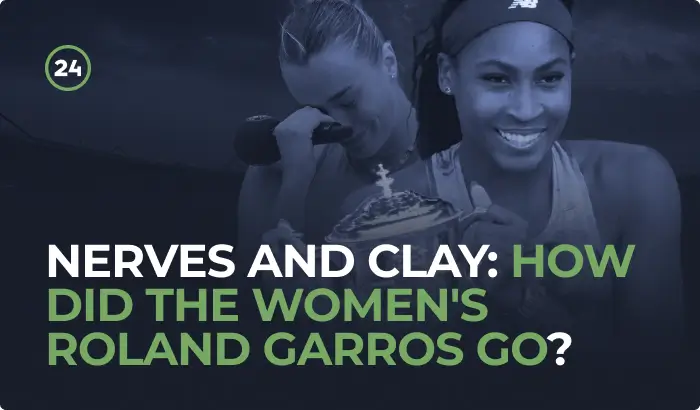
So what happened in the most important match? The final featured the world’s number one and number two players. Such a matchup hadn't occurred in over ten years. Aryna Sabalenka and Coco Gauff, just like in Madrid, decided to determine who was stronger and worthy of taking the title. However, this time the result was different from the one in the Spanish capital. The Belarusian knocked out Iga Swiatek in the semifinals, with whom she had a complicated head-to-head history. But with Gauff, it was even: 10 meetings and 5 wins each.
The final was close, but with a tilt to one side. Gauff only lost the first set in a tiebreak, committing half of her unforced errors. After that, Coco started retrieving all the winners sent her way by Sabalenka. This caused Aryna to become nervous and lash out at her coaching staff. There was a lot of shouting, which led to nothing. The Belarusian made 70 unforced errors during the match, which ultimately destroyed her. In the second and third sets, Gauff moved faster, played smarter, was fresher, and remained calm.
Nerves were the key aspect in this entire story called "Roland Garros." Nerves prevented Mirra Andreeva from reaching the semifinals and Aryna Sabalenka from winning the trophy. Lua Boisson and Coco Gauff, on the other hand, demonstrated that the right mindset and stability yield results.