What Is Futsal? Rules, Key Differences and Betting
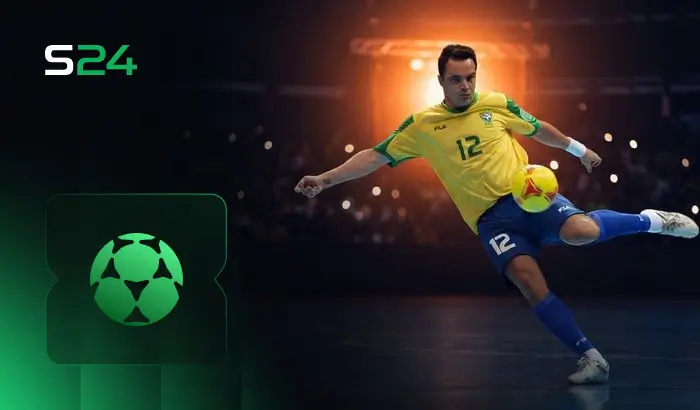
Futsal is a form of football played on a small court by two teams of five. Matches are fast-paced, and the limited space forces players to make quick decisions, pass accurately and keep moving. Futsal differs from traditional football not only in pitch dimensions but also in match duration, substitutions and the way fouls are penalised. We explain how the sport works, which competitions matter most and what to consider when betting on futsal matches.
What Is Futsal?
Futsal is a team sport governed by the official laws of the Fédération Internationale de Football Association (FIFA). Its name comes from the Spanish fútbol sala and Portuguese futebol de salão, both referring to indoor football.
Unlike eleven-a-side football, matches are usually played on a hard surface inside a sports hall. A standard team consists of four outfield players and a goalkeeper. The small court and limited number of players make the game dynamic: attacks follow one another quickly, and even a minor mistake can create a dangerous chance.
Futsal places particularly high demands on technique. Players need to control the ball confidently, escape pressure quickly and find teammates over short distances.
The Main Rules of Futsal
Although futsal resembles football, it has its own laws. Here are the main features.
How Many Players Are There in Futsal?
Each team has five players on the court at a time, including the goalkeeper. There is no limit on the number of substitutions, and players may be replaced during play through a designated substitution zone.
This allows coaches to rotate combinations regularly, maintain a high tempo and use different tactical systems.
How Long Does a Futsal Match Last?
A match consists of two 20-minute halves of effective playing time. The clock stops whenever the ball goes out of play or the referee stops the game.
As a result, the actual duration of a match is considerably longer than 40 minutes. In knockout competitions, a draw may lead to extra time and a penalty shoot-out.
Each team is also entitled to one one-minute timeout in each half.
Fouls and Red Cards in Futsal
One of futsal's defining features is the system of accumulated fouls. Once a team has committed five fouls in a half, each subsequent infringement covered by the relevant rules gives the opposition a free kick without a defensive wall, usually taken from the ten-metre mark.
Yellow and red cards are used for serious infringements. After a sending-off, a team generally plays a player short for two minutes. Under certain conditions, if the opposition score before those two minutes have elapsed, the team may restore its full complement of players.
Court Dimensions and the Futsal Ball
In international matches, the court measures between 38 and 42 metres in length and between 20 and 25 metres in width. The goals are 3 metres wide and 2 metres high.
Futsal uses a size-four ball with a reduced bounce. This makes it easier to control on a hard surface and helps players execute quick passing combinations.
How Is Futsal Different from Football?
| Parameter | Futsal | Football |
|---|---|---|
| Players on the pitch | 5 a side | 11 a side |
| Match duration | Two 20-minute halves | Two 45-minute halves |
| Timekeeping | Stopped clock (effective playing time) | Running clock with added time |
| Substitutions | Unlimited | Usually up to five |
| Goal size | 3 × 2 m | 7.32 × 2.44 m |
| Offside | No | Yes |
| Restarts from the touchline | Kicked in | Thrown in |
Major Futsal Tournaments
Futsal is played both by national teams and in club competitions.
The FIFA Futsal World Cup is the sport's leading international tournament, bringing together the strongest national teams from different continents. Historically, teams from South America and Europe have been particularly successful.
The UEFA Futsal EURO brings together Europe's leading national teams. The competition is highly competitive and regularly showcases clashes between the strongest futsal traditions.
The UEFA Futsal Champions League is Europe's leading club competition. It features champions and other representatives of domestic leagues that qualify under the competition regulations.
There are also championships in Asia, South America and other regions, alongside domestic leagues featuring professional clubs.
Futsal Betting: What Should You Consider?
Futsal attracts not only spectators but also sports bettors. Bookmakers offer markets such as match winners, total goals, handicaps, half-time results and other outcomes. However, analysing a bet requires an understanding of the sport's distinctive characteristics.
Total Goals
One popular market concerns the number of goals scored. To assess a total-goals bet, consider the teams' scoring records, defensive quality, strength of opposition and the specific tournament.
Relying solely on average goals is risky. For example, a team that scores freely against weaker opponents will not necessarily produce the same return against an organised side.
Match Winner and Handicap
When choosing a match winner, consider current form, squad depth and the team's ability to maintain a high tempo throughout the game.
Handicap betting may be appealing when there is a clear gap in quality. Nevertheless, even a favourite can struggle against an opponent that defends reliably and counters effectively.
Second-Half Betting
The second half deserves particular attention. Accumulated fouls, fatigue and the need to come from behind can substantially change the nature of a match.
The tactic of deploying a fifth outfield player is especially important. It can create more chances at both ends but does not guarantee a high-scoring game.
How to Analyse Futsal Matches
Before placing a bet, it is worth assessing several factors:
- Team form. Recent results, taking into account the quality of the opposition.
- Goalscoring. Average goals scored and conceded, considered separately for home and away fixtures.
- Squad availability. The absence of regular starters, the goalkeeper or key set-piece takers.
- Fixture schedule. Congestion, rest days and possible squad rotation.
- Competitive motivation. The need to win, group position and competition format.
- Style of play. Pressing intensity, defensive organisation and use of a fifth outfield player.
FAQ
Are Futsal and Five-a-Side Football the Same Thing?
In sporting terminology, futsal and five-a-side football are often used interchangeably. However, there are other forms of small-sided football whose rules may differ from FIFA's official futsal laws.
How Many Minutes Does a Futsal Match Last?
A match has two 20-minute halves of effective playing time. The clock stops whenever play is stopped.
Which Bets Are Popular in Futsal?
Common markets include match winners, total goals, handicaps and the results of individual halves. The availability of particular markets depends on the bookmaker and competition.